 Sep 01,2026
One day you need 50,000 4oz espresso cups for a coffee chain. The next week, a food delivery platform orders 150,000 16oz large cups for soup and noodles. Your machine can produce both—but every time you switch sizes, the line stops for an hour. The question isn't “which machine is fastest?”—it’s “which equipment stays productive when your cup sizes keep changing?”
For manufacturers serving diverse customers, the ability to produce multiple cup sizes on the same equipment is not a luxury—it’s a business necessity. But the path to flexibility is not one-size-fits-all. Some operations benefit from a single flexible machine; others are better served by multiple dedicated lines. This guide walks through the real factors that determine which approach works for your production reality: changeover time, speed trade-offs, mold economics, and order mix patterns.
The Real Bottleneck: Changeover Time, Not Cycle Speed
Many buyers fixate on “cups per minute” when evaluating equipment. But when you produce cups across multiple sizes on the same machine, mold swapping frequency becomes the true productivity killer.
What Actually Happens During a Size Change
Switching from an 8oz to a 16oz cup involves more than just swapping molds. The operator must adjust:
-
Paper feed timing and tension—different cup sizes require different blank dimensions
-
Side seam sealing temperature—larger cups need more heat for proper bonding
-
Bottom curling pressure—the curling depth must be recalibrated
-
Cup ejection timing—to ensure proper stacking without jams
On a conventional machine, this process takes 30–45 minutes. Some basic lines may take 45–60 minutes to complete a full changeover. For a shop that changes cup sizes 3–4 times per week, these hours add up quickly.
The 10-Minute Benchmark
Modern intelligent machines with quick-change mold systems and recipe storage can reduce changeover time to 5–10 minutes. The key enablers are:
-
Recipe storage—the machine remembers optimal parameters (temperature, pressure, speed) for each cup size
-
Quick-release mold systems—molds can be swapped without heavy tools or re-alignment
-
Servo-driven adjustments—multiple axes reposition simultaneously with one command
For a packaging converter running 10 different cup sizes weekly, the time saved across changeovers can exceed 5 hours per week. That’s productive capacity recovered without buying a second machine.For a detailed look at how different machine architectures affect production speed and stability across various cup sizes, see our paper cup machine series overview.
One Machine vs. Multiple Lines — A Decision Framework
There is no universally “right” answer. The choice between a single flexible machine and multiple dedicated lines depends on your specific production profile.
The Trade-Offs at a Glance
| Factor | Single Flexible Machine | Multiple Dedicated Lines |
|---|---|---|
| Changeover time | 5–60 minutes per switch | Zero (each line runs its own size) |
| Capital investment | Lower (one machine) | Higher (multiple machines) |
| Floor space | Less | More |
| Speed per size | May be optimized for one size, slower on others | Each line optimized for its specific size |
| Order flexibility | High—can adapt to any order mix | Low—requires minimum volume per size |
| Maintenance complexity | One machine to maintain | Multiple machines, multiple spare parts |
| Ideal for | Diverse orders, frequent size changes | High-volume standard sizes, limited SKUs |
Three Questions to Ask Yourself
1. How many cup sizes do you run weekly?
If you produce 1–2 sizes predominantly, with occasional runs of other sizes, a dedicated line for your main size plus a flexible secondary machine may be the most cost-effective approach.
If you regularly produce 5+ sizes in small to medium batches, a single flexible machine with fast changeover likely makes more sense than buying five separate lines.
2. What is your weekly order volume per size?
A basic rule of thumb: if your volume for a given size exceeds 200,000 cups per week, a dedicated line for that size may be justified. For lower volumes, the capital cost of a dedicated line is hard to recover.
3. How predictable is your order mix?
If your customers order the same sizes month after month, dedicated lines reduce changeover waste. If orders are unpredictable—seasonal peaks, new product launches, custom promotions—flexibility becomes a competitive advantage.
When Multiple Lines Make Sense
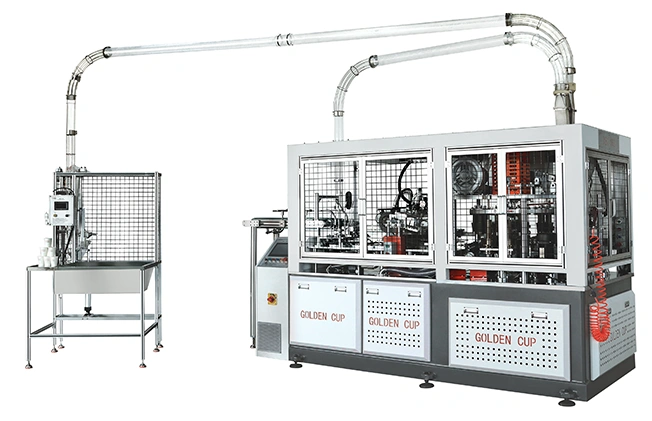
Some manufacturers choose to run three machines simultaneously, each producing a different cup size (e.g., 8oz, 12oz, and 16oz). However, it requires significant capital investment and floor space—and each line must have sufficient volume to justify its operation.To understand how different machine configurations—single-wall, double-wall, and bowl machines—perform across various production scenarios, explore our solution overview for paper container manufacturing.
Speed vs. Flexibility — The Hidden Trade-Off
A machine that runs 200 cups per minute on one size may run significantly slower on another. This is one of the most overlooked factors in equipment selection.
Why Speed Varies by Cup Size
Cup size directly affects cycle time. A 4oz espresso cup runs faster than a 16oz large cup because the forming cycle is shorter—less heating, less cooling, less material to move. Larger cups (12–16oz) typically run 10–20% slower than small cups on the same machine.
Double-wall cups add another layer of complexity. They require an extra bonding station, reducing speed by 20–30% compared to single-wall production on the same machine.
The Specification Trap
Some machines achieve high speeds but only within a narrow cup size range. For example, a model might run 120–140 cups per minute but only up to 10oz—while a more flexible model covers up to 16oz at 80–90 cups per minute.
The pattern to observe is not the highest number—it’s how cup size and speed move together. A machine that covers your entire size range at a slightly lower speed may deliver higher effective output than a faster machine that forces frequent changeovers or cannot handle your larger sizes at all.
Realistic Speed Expectations
| Cup Size Range | Typical Speed Range (CPM) | Notes |
|---|---|---|
| 2–9oz (small) | 100–140 | Highest speeds, shortest cycles |
| 4–16oz (medium) | 80–120 | Most common range, good flexibility |
| 16–22oz (large) | 60–90 | Slower due to longer heating/cooling |
| Double-wall (any size) | 60–100 | Extra bonding station reduces speed |
For specific guidance on cup sizes and material compatibility across different product types, see our application pages for paper cups, paper bowls, and double-wall insulated cups.
Mold Economics — The Cost of Flexibility
Molds are the physical interface between your machine and your cup size. Understanding mold types and costs is essential for realistic planning.
Full-Set vs. Half-Set Molds
-
Half-set molds change only the upper portion of the mold while keeping the same bottom diameter and cup angle. This is faster (typically a few hours) and less expensive.
-
Full-set molds change the entire mold—different bottom diameter, different angle. This takes significantly longer—up to 2 days of work.
The Practical Implication
If your cup sizes share the same bottom diameter, you can switch between them using half-set molds—saving both time and mold costs.
If your sizes have different bottom diameters, every change requires a full mold swap—which means longer downtime and higher mold inventory costs.
What to look for in a flexible machine:
-
Half-set mold compatibility across multiple cup sizes
-
Clear marking on each mold set (top diameter, bottom diameter, height)
-
Well-documented change procedures
Mold Inventory Planning
If you plan to run 5 different cup sizes, you need molds for all 5 sizes. That’s a significant upfront investment. Some manufacturers mitigate this by:
-
Standardizing on a small number of bottom diameters across their product line
-
Investing in quick-change mold systems that reduce labor time per swap
-
Keeping spare molds for high-volume sizes to minimize downtime during maintenance
Real-World Application — Two Production Scenarios
Scenario A: The Diverse Order Producer
A mid-sized manufacturer serves coffee shops, fast-food chains, and food delivery platforms. Weekly orders include 4oz, 8oz, 12oz, and 16oz cups—with volumes varying by season.
Key considerations:
-
Changeovers happen 3–5 times per week
-
No single size dominates volume
-
Order mix is unpredictable
Recommended approach: One flexible machine with quick-change capability and recipe storage. The investment in fast changeover (under 15 minutes) pays for itself within months by recovering productive hours.
Expected outcome: Effective daily output of 60,000–80,000 cups across multiple sizes, with changeover downtime under 2 hours per week.
Scenario B: The High-Volume Standard Producer
A large manufacturer supplies a national coffee chain with 8oz and 12oz cups exclusively. Weekly volume exceeds 500,000 cups, split evenly between the two sizes.
Key considerations:
-
Only two sizes, both high volume
-
Changeovers are predictable and infrequent
-
Maximum speed per size is the priority
Recommended approach: Two dedicated lines—one for 8oz, one for 12oz. No changeovers means zero downtime between sizes. Each line can be optimized for its specific size.
Expected outcome: Combined daily output exceeding 200,000 cups, with no changeover-related downtime.
Next Steps — From Decision Framework to Equipment Evaluation
Understanding the factors that affect multi-size production is the first step in making an informed equipment decision. The key takeaways:
-
Changeover time matters more than brochure speed when you run multiple sizes—a 10-minute changeover vs. 45 minutes can recover 5+ hours of production weekly
-
Speed varies by cup size—larger cups and double-wall configurations run 10–30% slower than small single-wall cups
-
Mold strategy affects both cost and downtime—half-set molds are faster and cheaper; full-set molds require significant planning
-
One flexible machine vs. multiple dedicated lines depends on your order volume, size variety, and predictability
-
Recipe storage and quick-change tooling are not nice-to-have—they are essential for multi-size production efficiency
Once you have clarified these key decision factors—your typical cup size range, changeover frequency, weekly volume per size, and mold requirements—comparing the specific specifications of available equipment becomes the next logical step. You can review high-speed options for high-volume single-size scenarios, or explore models optimized for flexible production with quick-change capabilities and recipe storage.For practical guidance on maintenance practices that sustain output across frequent changeovers, see our paper cup machine service overview. To stay current with industry trends and technical developments, visit our news and blog section.
Related Reading
-
Paper Cup vs. Paper Bowl Production: Key Differences in Machine Selection
-
How to Plan a Flexible Paper Cup Production Line for Multiple Cup Sizes
-
Understanding Double-Wall Cup Production: Process, Challenges, and Solutions
-
How to Choose Paper Cup Equipment for High-Volume Production
-
How Does a Salad Bowl Machine Improve Efficiency and Quality in Food Production?
This article is part of Golden Cup’s technical content library. No direct sales or pricing information is included. All technical discussions aim to help you make informed purchasing decisions.