 Aug 15,2026
Scaling up paper cup production is a pivotal decision. The gap between a pilot line and a high-volume operation is not just about speed—it is about reliability, material compatibility, labor efficiency, and total cost of ownership. Choosing the wrong machine for your target volume can mean chronic downtime, excessive waste, or being unable to meet delivery commitments.
This guide provides a practical decision framework for evaluating a paper cup machine for high-volume production. Rather than focusing on specific models, we examine the core technical and operational factors that determine whether a machine can deliver consistent output at scale.
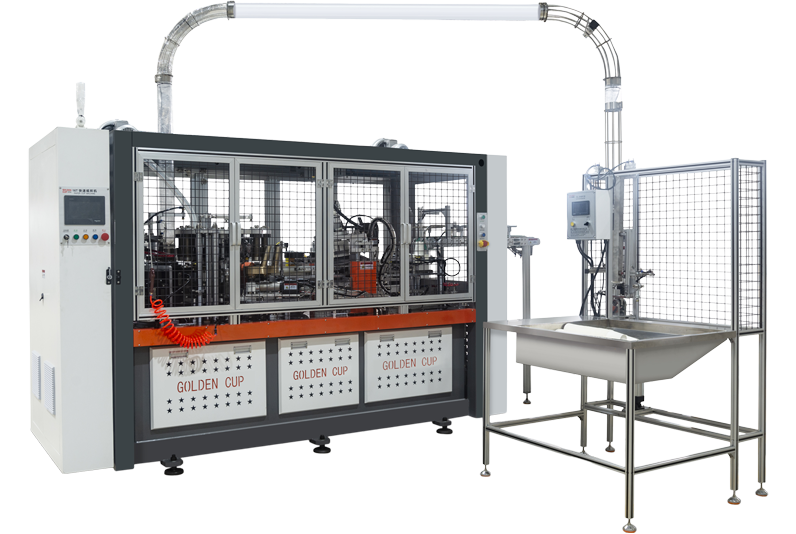
Understanding What "High-Volume" Means for Your Production Line
Before comparing equipment options, it helps to define what high-volume production means in your specific context. In the paper cup industry, production speed typically falls into three tiers:
| Production Tier | Speed Range (cups/min) | Typical Application |
| Entry-level / Startup | 40 – 80 | Small batch runs, sample production, regional distribution |
| Mid-volume / Growing | 80 – 130 | Multiple SKUs, expanding customer base, shift-based production |
| High-volume / Industrial | 130 – 200+ | 24/7 operation, large contracts, cost-per-unit competitive advantage |
High-volume production is not simply about peak speed—it is about sustained throughput at acceptable quality levels over long production runs. A machine rated for 160 cups per minute may only deliver 120–130 cups per minute in practice when accounting for paper feeding adjustments, stoppages, and quality checks.
Key takeaway: Define your target output as a sustainable hourly rate, not a brochure maximum. If your goal is 100,000 cups per 8-hour shift, you need equipment that can reliably produce 210 cups per minute, factoring in planned downtime for maintenance and changeovers.
The Technical Decision Framework – Five Critical Considerations
Evaluating paper cup equipment for high-volume production requires looking beyond speed figures. The following five factors form the foundation of a sound selection process.
1. Drive System Architecture – Long-Term Reliability
The internal drive system determines machine lifespan and maintenance frequency. Three common architectures exist:
-
Chain-driven systems – Found in older or lower-cost machines. Chains stretch over time, causing registration errors and requiring frequent tension adjustments. Typical service life: 3–5 years under continuous operation.
-
Open cam systems – An improvement over chains, but exposed cams require manual lubrication and are susceptible to dust contamination in production environments.
-
Enclosed oil-bath gearbox – The modern standard for high-volume production. Cams and gears run inside sealed housings with continuous spray lubrication, significantly reducing friction and wear. This design supports 10+ years of operation with minimal maintenance.
Why this matters for high-volume production: In a 24/7 operation, every hour of unscheduled downtime costs revenue and risks delivery penalties. A robust drive architecture reduces the frequency of mechanical failures and the labor required for routine maintenance. For a detailed overview of available drive technologies, you can review the paper cup machine series overview.
2. Material Compatibility – Not All Paper Feeds the Same
Paper cup machines are calibrated for specific paper properties, including grammage (weight per unit area), coating type, and stiffness. A common mistake is assuming that a machine that runs well on high-quality 250gsm paper will perform identically on 190gsm material.
Key material considerations for high-volume production:
-
Paper weight range: Verify that the machine can handle the specific grammage you plan to use in production—not just the test paper used during factory demonstrations.
-
Coating compatibility: PE-coated paper, PLA-coated (biodegradable) materials, and water-based coatings each require different heating and sealing configurations.
-
Consistency: In high-volume production, material quality fluctuations that were tolerable at low speeds become significant sources of jams and rejects at high speeds.
3. Sealing Technology – Hot Air vs. Ultrasonic
The choice between hot air and ultrasonic sealing directly impacts your product range and operational cost.
| Sealing Method | Best For | Considerations |
| Hot Air (Copper/Heat-based) | Single PE-coated hot drink cups | Lower initial cost; simpler maintenance; risk of burning outer coating on double-PE cups |
| Ultrasonic | Double PE-coated cold drink cups, PLA/biodegradable materials | Higher initial investment; seals from the inside out without surface damage; essential for condensation-resistant cups |
For high-volume production, using the wrong sealing technology leads to unacceptable defect rates. Double-PE cups run on hot air systems often show burn marks and higher leak rates. If your product portfolio includes cold drink cups or biodegradable materials, ultrasonic sealing is a requirement, not an option. For applications involving insulated cup structures, refer to the double wall paper cup machine technical overview.
4. Automation and Labor Integration – The Real Cost of Speed
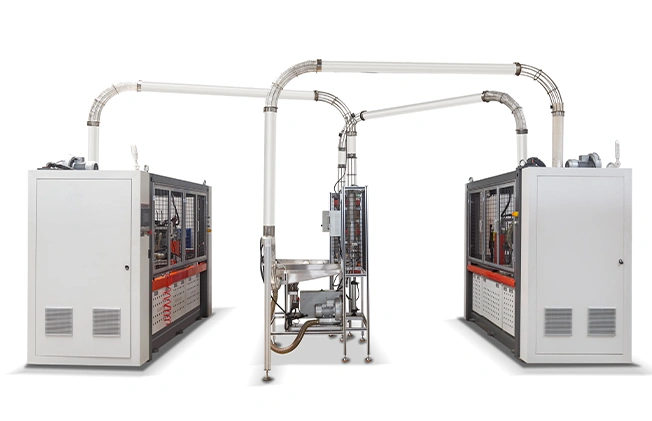
A high-speed machine that requires constant manual intervention may not improve overall production efficiency. Automation features that matter for high-volume operations include:
-
Automatic collection and stacking: At speeds above 80 cups per minute, cups exit the machine at approximately 2 cups per second. Without an automatic collection unit, you need multiple operators just to catch and stack finished products. This erases the labor savings that high-speed equipment is supposed to deliver.
-
Photoelectric detection and rejection: Automated sensors detect misfeeds, registration errors, or defective cups and reject them without stopping the line. This reduces waste and maintains quality standards.
-
Auto-stopping sensors: When an issue is detected, the machine stops automatically, preventing damage and allowing a single operator to manage multiple machines.
Labor calculation example: A low-speed machine at 45 cups per minute typically requires one dedicated operator. A high-speed intelligent machine at 120+ cups per minute, equipped with auto-stop sensors and visual fault detection, allows one operator to manage 3–4 machines. Over a 20-hour production day, the labor cost per cup decreases substantially. For solutions that integrate forming with downstream handling, explore the paper cup packaging machine line.
5. Mold Change Flexibility vs Dedicated Production
In high-volume production, mold change frequency is a critical planning variable. Changing a mold on a paper cup machine—replacing the forming turret, bottom punch, knurling wheels, and rim curling dies—typically takes a skilled technician 3 to 6 hours. For an average operator, it can take a full day to restore smooth operation.
Decision framework:
-
If your production plan involves producing multiple cup sizes (e.g., 4oz, 8oz, 12oz) on the same machine, you must account for changeover time in your capacity planning.
-
If your volume justifies it, dedicating separate machines to your best-selling sizes eliminates changeover downtime entirely and reduces operator error.
Calculating Sustainable Capacity – The 80% Rule
One of the most common mistakes in high-volume equipment selection is designing production plans around maximum rated speed. A machine rated for 100 cups per minute typically runs stably at 80–85 cups per minute over long shifts. Pushing a machine to its limit 24/7 accelerates wear, increases vibration, and leads to more frequent failures.
The 80% capacity guideline:
-
If your target is 100 cups per minute, select equipment rated for 120–140 cups per minute.
-
Run production at approximately 80% of rated maximum to maintain stability, extend component life, and allow for material variations.
This approach also provides headroom for periodic speed increases if demand grows, without requiring immediate equipment replacement.
Total Cost of Ownership – Beyond the Purchase Price
For high-volume production, the purchase price of equipment is a fraction of the total cost of ownership (TCO). Key TCO components include:
| Cost Category | Impact on High-Volume Production |
| Downtime cost | Production stoppages on a high-volume line cost significantly more than on a low-volume line due to lost output volume |
| Spare parts availability | Just-in-time parts procurement is risky. A $50 heater that fails and takes 5 days to ship from overseas can cost thousands in lost production |
| Paper waste | Machines that produce inconsistent seals or have high reject rates generate more waste—both in materials and in rework labor |
| Energy efficiency | Drive systems with regenerative braking (common in modern servo-driven machines) can reduce heat generation and energy consumption compared to older resistor-based braking systems |
Practical recommendation: For any high-volume installation, purchase a spare parts package (heaters, springs, bearings, knurling wheels) upfront. The cost is minor compared to the impact of unplanned downtime.
Case in Point – The High-Volume Production Scenario
Consider a manufacturer targeting 2 million cups per month from a single line. Working 24 days per month, 8 hours per shift, the required production rate is approximately:
-
2,000,000 ÷ 24 days = 83,333 cups per day
-
83,333 ÷ 8 hours = 10,416 cups per hour
-
10,416 ÷ 60 = 174 cups per minute required
Using the 80% capacity guideline, this manufacturer should evaluate equipment rated for approximately 210–220 cups per minute to provide stability headroom.
Key equipment considerations for this scenario:
-
Drive system: Enclosed oil-bath gearbox for long-term reliability
-
Sealing: Ultrasonic if the product line includes cold cups or PLA materials
-
Automation: Automatic collection and stacking to minimize labor costs at high output rates
-
Spare parts: On-site inventory of critical components
This scenario illustrates why the selection process must be driven by business targets, not by equipment specifications alone.
Next Steps – From Decision Framework to Equipment Evaluation
Once these decision factors are clarified—sustainable speed, material compatibility, sealing requirements, automation needs, and total cost of ownership—the next logical step is to evaluate specific equipment architectures that align with your production targets.
If your operation requires high-speed, flexible production with frequent size changes, servo-driven architectures provide advantages in changeover speed and precision. For dedicated high-volume, single-size production, cam-driven systems offer rugged reliability and lower maintenance costs.
You may also want to explore how different forming technologies—from traditional mechanical cam systems to fully servo-controlled configurations—affect production stability and maintenance intervals for your specific application. For a comprehensive comparison of available configurations, visit the paper cup machinery products overview page.
Related Reading
-
Understanding the Total Cost of Ownership in Paper Cup Manufacturing
-
Comparing Drive Systems: Servo vs Cam vs Hybrid for Paper Cup Machines
-
Material Compatibility Guide: PE, PLA, and Beyond
-
Automation Strategies for Reducing Labor Costs in Cup Production
-
Maintenance Planning for High-Volume Paper Cup Lines