 Sep 14,2026
You've decided to enter the paper cup manufacturing business. Or you're expanding an existing operation. Either way, you face the same question: What equipment do I actually need, and how do I avoid buying the wrong machine?
The global paper cups market was valued at approximately US$9.0 billion in 2025** and is projected to reach **US$10.8 billion by 2032, growing at a CAGR of 2.5%. With coffee chains, quick-service restaurants, and food delivery services expanding worldwide, demand for paper cups continues to rise. But equipment decisions made at the start of a factory setup—or during a capacity expansion—determine your cost structure for years to come.
This guide provides a decision framework for the key equipment considerations in paper cup factory setup. It's not about which machine is fastest. It's about which equipment matches your production reality: your cup sizes, your order mix, your labor availability, and your growth plans.
The Speed Trap: Why Brochure Speed Isn't Your Real Capacity
The first equipment decision most buyers face is speed. High-speed machines promise 150–200 cups per minute. But that number tells you less than you think.
What "High Speed" Actually Means
Industry standards in 2026 define high-speed paper cup machines as those running 120 to 200 cups per minute, depending on cup size (4oz to 24oz) and wall type. Machines running more than 150 cups per minute typically use servo-driven forming systems and ultrasonic sealing.
But here's the critical distinction: rated speed and sustained output are different numbers. A machine that peaks at 200 CPM may sustain only 140–160 CPM over a full shift. In a well-managed factory, Overall Equipment Effectiveness (OEE) is typically 85% to 90%—meaning your realistic output is 10–15% below the stable running speed before you even account for changeovers and material issues.
Speed vs. Stability: The Real Trade-Off
| Machine Tier | Speed Range (CPM) | Uptime Reliability | Best Fit |
|---|---|---|---|
| Medium-speed | 80–120 | Stable, lower maintenance | Established operations, moderate volume |
| High-speed (servo) | 150–200 | Higher uptime with proper maintenance | High-volume single-size production |
| Full servo + ultrasonic | 120–200+ | Highest uptime, lowest scrap | Export-focused, multi-size, quality-critical |
A machine with a slower stable speed but higher uptime often delivers more saleable cups per shift than a faster machine prone to jams and downtime. At 200 cups per minute, a jam every 10 minutes adds just 3 seconds of downtime per minute—but that still represents a 5% capacity loss.For a detailed comparison of how different machine architectures perform across cup sizes and production scenarios, see our paper cup machine series overview.
The Hidden Cost Drivers: What Factory Setup Really Costs
Beyond the machine itself, factory setup involves equipment, energy, labor, and waste management. Understanding these cost drivers before you buy helps you avoid the "cheap machine, expensive operation" trap.
Equipment Investment Ranges
A fully automated paper cup production line typically ranges from $35,000 to $85,000, depending on speed, automation level, and included auxiliary equipment. A complete starter line with printing capability falls in the $35,000–$90,000 range, while high-speed dedicated lines can reach $80,000–$250,000 or more.
The Energy Equation
Energy cost per cup is a frequently overlooked factor. A high-speed machine produces more cups but uses more energy per cup:
| Metric | Low Speed (80 CPM) | High Speed (180 CPM) |
|---|---|---|
| Units per hour | 4,800 | 10,800 |
| Energy cost/1,000 cups | ~$0.80 | ~$1.10 |
| Operators needed | 2–3 | 1–2 |
| Break-even volume/month | ~200,000 cups | ~400,000 cups |
Source: Packaging Machinery Technology Review, cited by UNITELY MACHINERY.
High-speed machines use more energy per cup, but they reduce labor costs and pay for fixed costs faster. If you run 16 hours a day, a 180 CPM machine can produce more than 100,000 cups daily. At that volume, the cost-effectiveness of faster machines becomes clear.
The Waste Factor
Waste is another hidden cost. In a medium-sized paper cup factory, approximately 5–10% of raw materials end up as waste during production. Modern machines with recipe storage and servo control can reduce scrap rates from 8–12% during setup to just 2–4% with recipe recall.
For a factory producing 100,000 cups daily, reducing scrap from 8% to 3% saves 5,000 cups worth of material every single day. Over a year, that's millions of cups in recovered material. For a comprehensive look at how integrated production lines—from printing to packing—can minimize material waste, explore our production line integration solutions for reducing material waste.
Precision and Automation: The Quality-Output Connection
Speed alone doesn't determine output. A machine that produces cups quickly but with high defect rates delivers lower effective output than a slower machine with near-zero defects.
Servo vs. Mechanical: What the Numbers Show
The choice between servo-driven and traditional mechanical machines is one of the most consequential equipment decisions. Here's how they compare:
| Feature | Full Servo | Traditional Mechanical |
|---|---|---|
| Precision | ±0.05mm | ±0.2mm (prone to wear) |
| Speed adjustment | Real-time, stepless | Requires gear changes |
| Energy use | 15–25% less (power on demand) | Continuous high consumption |
| Maintenance cost | 60% lower annually | Frequent cam/belt replacement |
| Changeover time | Under 5 minutes (recipe recall) | 15–40 minutes |
| Scrap rate (setup) | 2–4% with recipe recall | 8–12% |
Source: Industry technical comparisons from multiple equipment manufacturers.
The Practical Impact of Precision
A precision of ±0.05mm means tighter seals, fewer leaks, and more consistent cup dimensions. For a factory producing 100,000 cups per day, a 1% reduction in defect rate translates to 1,000 more saleable cups daily—without any increase in machine speed.
Recipe Storage: The Underrated Feature
One of the most valuable automation features for multi-size production is recipe storage. On a machine with recipe recall, the operator selects the cup size from a touchscreen, and the system automatically sets paper feed length, sealing temperature, curling pressure, and ejection timing. A changeover that previously took 45 minutes of manual adjustment can be completed in under 10 minutes.
For manufacturers producing multiple cup sizes, this feature alone can recover an hour and a half of production per shift.For specific guidance on cup sizes and material compatibility across different product types, see our application pages for paper cups, paper bowls, and double-wall insulated cups.
Compliance and Material Handling: Setting Up for Global Markets
If you plan to export, compliance with food-contact regulations is non-negotiable—and it affects your equipment choices.
Key Standards to Plan For
China: GB 4806.8-2022 — Effective June 30, 2023, this standard specifies sensory requirements, physicochemical indices, and migration limits for food-contact paper and paperboard materials. The 2022 revision added limits for 1,3-dichloro-2-propanol and 3-chloro-1,2-propanediol.
EU: Regulation (EC) No 1935/2004 — The framework regulation governing all food-contact materials in the European Union. It requires that materials be manufactured according to Good Manufacturing Practice (GMP) and that constituents not transfer to food in quantities that pose a health threat.
US: FDA 21 CFR Parts 176–178 — Provides regulations for food-contact substances including paper, polymers, adhesives, and inks.
Material Handling Equipment
A complete production line typically includes:
-
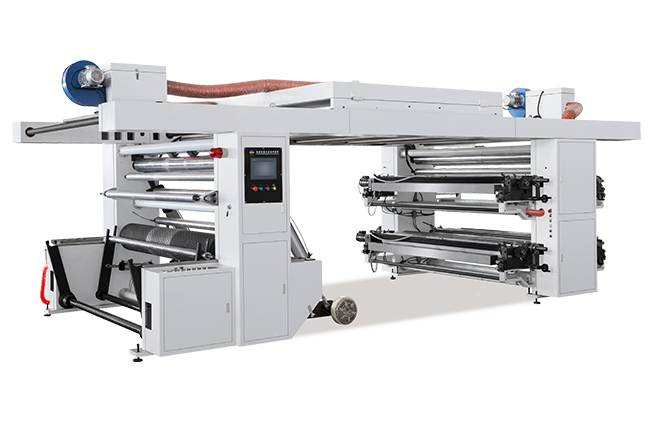
Printing machine — Applies logos and designs to paper rolls before forming. Flexographic or digital printers are common choices.
-
Die-cutting machine — Cuts printed paper into cup blanks with precise dimensions.
-
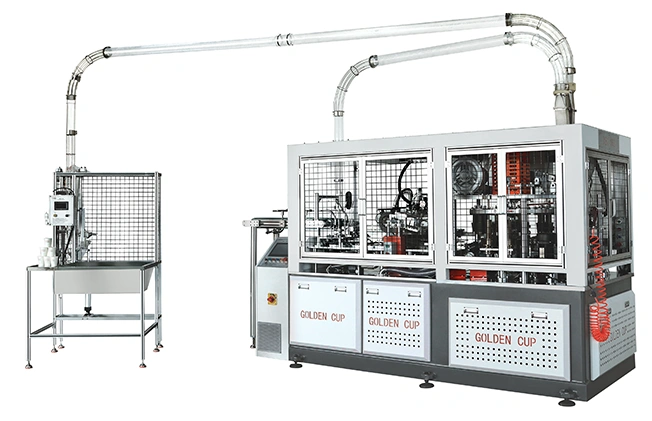
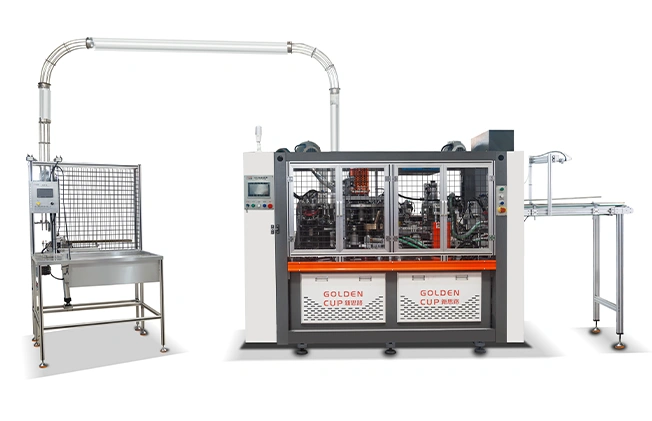
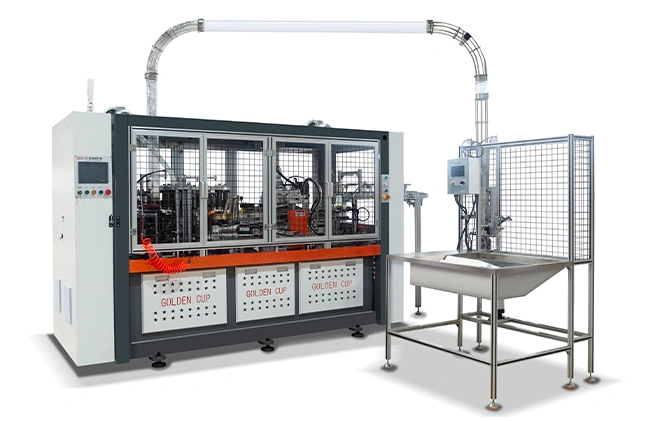
Forming machine — The core equipment that shapes, seals, and finishes the cup.
-
Packaging machine — Automates counting and packaging, reducing manual labor.
Material Compatibility
Your forming machine must handle the paper weights your product mix requires. Food-grade paper ranges from 170–350 gsm, with heavier weights needed for larger cups. Coating type (PE, double PE, PLA, or water-based) also affects sealing parameters. Machines with adjustable temperature and pressure settings—or recipe storage—handle material variations more efficiently.
Real-World Application: Two Factory Setup Scenarios
Scenario A: The Regional Supplier
A manufacturer in Southeast Asia plans to serve local coffee chains and food delivery platforms. Expected volume: 300,000–500,000 cups per month across 8oz, 12oz, and 16oz sizes.
Key considerations:
-
Changeovers happen 3–5 times per week
-
Export compliance not initially required
-
Limited skilled labor available
Recommended setup:
-
One medium-to-high-speed servo machine (120–160 CPM range) with recipe storage
-
Printing capability for local branding
-
Basic packaging automation
-
Budget: $60,000–$120,000 for the core line
ROI expectation: 12–18 months, primarily from efficient multi-size production and reduced labor costs.
Scenario B: The Export-Oriented Producer
A manufacturer targets European and North American markets, requiring GB, EU, and FDA compliance. Expected volume: 1–2 million cups per month, primarily 8oz and 12oz single-wall cups.
Key considerations:
-
High volume, consistent cup sizes
-
Strict compliance requirements
-
Need for full production line integration
Recommended setup:
-
Two high-speed servo machines (160–200 CPM range) with ultrasonic sealing
-
Full flexographic printing line with food-safe inks
-
Automated die-cutting and packaging equipment
-
Budget: $150,000–$300,000 for the complete line
ROI expectation: 18–30 months, with quality consistency and compliance as key value drivers.
Next Steps—From Decision Framework to Equipment Evaluation
Planning a paper cup factory setup is not about finding the single "best" machine. It's about matching equipment to your production reality. The key takeaways:
-
Speed alone doesn't determine profitability — OEE of 85–90% means realistic output is 10–15% below stable running speed
-
Energy and waste are hidden costs — high-speed machines use more energy per cup but reduce labor and fixed costs faster
-
Servo precision pays for itself — ±0.05mm vs. ±0.2mm translates to fewer defects and higher saleable output
-
Recipe storage is essential for multi-size production — changeover time can drop from 45 minutes to under 10
-
Compliance drives material and equipment choices — plan for GB, EU, or FDA standards from the start
Once you have clarified these key decision factors—your target capacity, cup size range, compliance requirements, and automation level—comparing specific equipment specifications becomes the next logical step. You can review high-speed options for high-volume export scenarios, or explore flexible configurations for multi-size regional production.For practical guidance on maintenance practices that protect your investment over the long term, see our paper cup machine service overview.
Related Reading
-
How to Calculate Realistic Output for a New Paper Cup Factory
-
Servo vs. Mechanical Paper Cup Machines: Which Fits Your Factory Setup?
-
Hidden Costs in Paper Cup Production: Energy, Waste, and Labor
-
Compliance Checklist for Exporting Paper Cups to EU and US Markets
-
Choosing Between Single-Size and Multi-Size Production Lines