 Sep 07,2026
A coffee chain orders 50,000 8oz cups for its morning rush. A food delivery platform needs 120,000 16oz containers for soup and noodles. Your machine can produce both. But here is the question that determines whether you stay profitable: Can you produce them at the speed and quality your customers expect, without wasting half a shift on changeovers?
The global paper cups market was valued at approximately US$9.0 billion in 2025** and is projected to reach **US$10.8 billion by 2032, growing at a CAGR of 2.5%. As coffee chains, quick-service restaurants, and food delivery services expand worldwide, demand across multiple cup sizes continues to rise. For manufacturers serving diverse customers, the ability to match cup sizes to production requirements is not just about machine specifications—it is about understanding how size affects every aspect of your production line, from speed and material to changeover time and mold strategy.
This guide walks through the key factors that determine how well your production equipment matches your cup size requirements—so you can make informed decisions before you buy.
How Cup Size Affects Production Speed
The most common mistake in production planning is assuming that the brochure speed applies equally to all cup sizes. It does not.
The Size-Speed Relationship
Smaller cups run faster. Larger cups run slower. This is not a limitation of the machine—it is physics.
A 4oz espresso cup requires less paper, less heating, and less cooling time than a 16oz large cup. The forming cycle is shorter because there is less material to move and less surface area to seal. Conversely, a large cup demands more heat to bond the side seam, longer cooling time to set the seal, and more material handling throughout the process.
Industry data shows this relationship clearly:
| Cup Size | Typical Speed Range (CPM) | Key Consideration |
|---|---|---|
| 2–4oz (espresso, sample) | 100–160 | Shortest cycle, highest speed potential |
| 8–10oz (standard coffee) | 90–140 | Most common range, good balance |
| 12–16oz (large coffee, soup) | 70–110 | Longer heating/cooling reduces speed |
| 16–22oz (bowls, family size) | 50–80 | Slowest due to material volume |
A machine rated at 140 CPM on an 8oz cup may deliver only 90 CPM on a 16oz cup. This is not a defect—it is a fundamental characteristic of the forming process. A 2026 study published in the Journal of Manufacturing Processes examined how production speed affects cup quality, demonstrating that a curling depth of 4.3mm provides improved seal consistency and structural uniformity, particularly at lower production speeds (80 CPM), minimizing the risk of defects commonly observed in fast, high-volume manufacturing settings.
The Practical Implication
If your product mix includes large cups (16oz and above) or double-wall configurations, you must factor in the lower throughput when calculating capacity. A line that produces 120,000 8oz cups per shift may produce only 80,000 16oz cups—without any change in machine uptime.
For a detailed look at how different machine architectures handle various cup sizes and speed requirements, see our paper cup machine series overview.
Matching Cup Size to Paper Material
Cup size does not just affect speed—it affects the material you need to run. And material choice directly impacts both quality and production efficiency.
GSM by Cup Size
Paper weight is measured in GSM (grams per square meter). Larger cups require heavier paper to maintain structural integrity. A 4oz cup can use 170–190 GSM paper, while a 12oz cup typically requires 240–260 GSM, and 16–22oz cups may need 280+ GSM.
| Cup Size | Recommended Paper Weight (GSM) | Coating |
|---|---|---|
| 2.5–4oz | 150–190 | Single PE |
| 6–10oz | 190–230 | Single or Double PE |
| 12–16oz | 210–260 | Double PE |
| 20–32oz | 280+ | Double PE |
Why Material Matters for Production
Heavier paper requires more heat to seal properly. It also takes longer to form and cool. If your machine is optimized for 190 GSM paper but you run 280 GSM, you may experience:
-
Incomplete seals — the heat setting is too low for the thicker material
-
Increased jams — stiffer paper does not feed as smoothly
-
Slower cycle times — the machine needs more time to apply heat and pressure
For manufacturers exporting to regulated markets, material compliance is also non-negotiable. China's GB 4806.8-2022 standard for food-contact paper and paperboard materials—effective June 30, 2023—specifies sensory requirements, physicochemical indices, and migration limits. The standard added limits for 1,3-dichloro-2-propanol and 3-chloro-1,2-propanediol, among other updates. Similarly, the EU Regulation (EC) No 1935/2004 governs materials intended to come into contact with food.
The Practical Implication
If you plan to produce both small and large cups, your machine must handle a wide range of paper weights—or you must be prepared to adjust temperature, pressure, and timing settings for each size. Machines with recipe storage can recall these settings instantly, eliminating trial-and-error adjustments during changeovers.
For specific guidance on material compatibility across different cup types, see our application pages for paper cups, paper bowls, and double-wall insulated cups.
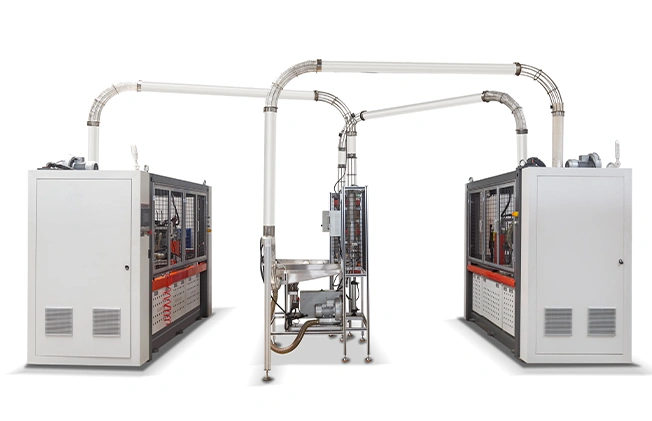
The Changeover Reality—From 8oz to 16oz
When you produce multiple cup sizes on the same machine, changeover time becomes the true productivity killer. Speed matters less than how quickly you can switch from one size to the next.
What Changes During a Size Change
Switching from an 8oz to a 16oz cup involves more than swapping molds. The operator must adjust:
-
Paper feed timing and tension — different cup sizes require different blank dimensions
-
Side seam sealing temperature — larger cups need more heat for proper bonding
-
Bottom curling pressure and depth — the curling depth affects seal consistency
-
Cup ejection timing — to ensure proper stacking without jams
The Time Gap
On a conventional machine, a full size change takes 30–45 minutes. On machines with quick-change mold systems and recipe storage, the same changeover can take 5–10 minutes.
The math is straightforward. A 10-minute changeover versus a 40-minute changeover across three size changes per shift adds 90 minutes of productive time—roughly a 15–20% increase in effective capacity without any increase in machine speed.
Half-Set vs. Full-Set Molds
Not all size changes are equal. The type of mold swap determines how long the changeover takes:
-
Half-set molds change only the upper portion while keeping the same bottom diameter and cup angle. This typically takes 1–2 hours for an experienced technician.
-
Full-set molds change the entire mold—different bottom diameter, different angle. This can take up to 2 days of work.
The Practical Implication
If your cup sizes share the same bottom diameter (e.g., 8oz and 12oz cups with the same base diameter), you can switch between them using half-set molds—saving both time and mold costs. If your sizes have different bottom diameters, every change requires a full mold swap—which means longer downtime and higher mold inventory costs.
To understand how different machine configurations support quick changeovers across multiple cup sizes, explore our application-specific solutions for paper container production
Sealing Technology and Cup Size
The sealing method your machine uses affects both quality and speed—and the impact varies by cup size.
Hot Air vs. Ultrasonic Sealing
A peer-reviewed study published in BioResources (2026) compared hot-air and ultrasonic sealing technologies in paper cup manufacturing. The research found that ultrasonic sealing has an advantage in sealing consistency over hot-air sealing. The study also developed a mechanical testing device to objectively compare side seal strength, replacing the subjective hand-peel method.
The sealing process requires three conditions:
-
Sufficient heat — to melt the polymer sealant
-
Pressure — to ensure proper wetting and penetration
-
Adequate time — for molecular chains to entangle
Why Size Matters for Sealing
Larger cups present greater sealing challenges:
-
More surface area requires more heat distribution
-
Thicker paper (higher GSM) needs higher temperatures
-
Longer cooling time is required to set the seal properly
Ultrasonic sealing eliminates warm-up time between changeovers and allows consistent sealing across a wider range of paper weights. This is particularly valuable for manufacturers producing multiple cup sizes, as it reduces the need for temperature adjustments between size changes.
The Practical Implication
If your production mix includes large cups (16oz and above) or double-wall configurations, sealing technology becomes a critical differentiator. A machine with superior sealing consistency will deliver higher effective output because fewer cups are rejected—and consistent sealing across sizes means less adjustment time during changeovers.
Real-World Application—Two Production Scenarios
Scenario A: The Diverse Order Producer
A mid-sized manufacturer serves coffee shops, fast-food chains, and food delivery platforms. Weekly orders include 4oz, 8oz, 12oz, and 16oz cups—with volumes varying by season.
Key considerations:
-
Changeovers happen 3–5 times per week
-
No single size dominates volume
-
Order mix is unpredictable
-
Cup sizes have different bottom diameters (full-set molds required)
Recommended approach: One flexible machine with quick-change capability, recipe storage, and ultrasonic sealing. The investment in fast changeover (under 15 minutes) pays for itself within months by recovering productive hours.
Expected outcome: Effective daily output of 60,000–80,000 cups across multiple sizes, with changeover downtime under 2 hours per week.
Scenario B: The High-Volume Standard Producer
A large manufacturer supplies a national coffee chain with 8oz and 12oz cups exclusively. Weekly volume exceeds 500,000 cups, split evenly between the two sizes. Both sizes share the same bottom diameter (half-set molds only).
Key considerations:
-
Only two sizes, both high volume
-
Changeovers are predictable and infrequent
-
Half-set molds reduce changeover time
Recommended approach: Two dedicated lines—one for 8oz, one for 12oz. No changeovers means zero downtime between sizes. Each line can be optimized for its specific cup size and paper weight.
Expected outcome: Combined daily output exceeding 200,000 cups, with no changeover-related downtime.
Next Steps—From Decision Framework to Equipment Evaluation
Understanding how to match cup sizes with production requirements is the first step in making an informed equipment decision. The key takeaways:
-
Cup size directly affects speed — larger cups run 20–40% slower than small cups on the same machine
-
Material weight varies by size — 4oz cups use 170–190 GSM; 12oz cups need 240–260 GSM
-
Changeover time is the real productivity killer — 10-minute vs. 40-minute changeovers can recover 90 minutes per shift
-
Mold strategy affects both cost and downtime — half-set molds are faster and cheaper; full-set molds require significant planning
-
Sealing technology impacts consistency across sizes — ultrasonic sealing offers advantages in sealing consistency
Once you have clarified these key decision factors—your typical cup size range, changeover frequency, weekly volume per size, paper GSM requirements, and mold strategy—comparing the specific specifications of available equipment becomes the next logical step. You can review high-speed options for high-volume single-size scenarios, or explore models optimized for flexible production with quick-change capabilities and recipe storage.
Related Reading
-
Paper Cup vs. Paper Bowl Production: Key Differences in Machine Selection
-
How to Estimate Your Production Capacity Across Multiple Cup Sizes
-
Changeover Best Practices for Multi-Size Paper Cup Production
-
Paper Cup Machine Speed vs. Quality: Finding the Optimal Balance for Different Cup Sizes